A permanent foundation for postpartum breast cancer research.

We are closing the gap between what we know about postpartum breast cancer and what is being done about it — with the same discipline we would apply to any serious, solvable problem.

For Katherine. And for every family that comes after.

Why This Exists

A gap we found by living through it.

The years immediately following childbirth, one of life’s most meaningful moments, are also among the most dangerous for breast cancer outcomes. And medicine has not caught up. This foundation exists to change that.
The Problem

Postpartum breast cancer is hiding in plain sight.

Breast cancer diagnosed within five years of childbirth: a clinically distinct window with markedly worse outcomes.

Incidence

Hidden by its framing.

5,000–7,000
U.S. families affected each year. A mother diagnosed within five years of childbirth.
~2%
of all U.S. breast cancer cases.
A small slice by count. An outsized share by outcome.
Outcomes

The evidence points in one direction.

Callihan et al., 2013
n = 619

Compared: PPBC vs. never given birth
65.8% 5-yr survival (PPBC)
98.0% 5-yr survival (nulliparous)
~2.7× higher risk of death
Zhang et al., 2022
n = 4,834

Compared: PPBC vs. never given birth
~1.5× higher risk of metastasis
~1.5× higher risk of death
5-yr survival not reported
Larger registry cohort; more moderate effect size
Park et al., 2022

Compared: PPBC vs. later postpartum diagnosis
89–91% 5-yr survival (early PPBC)
95–96% 5-yr survival (later group)
~2× higher risk of death
Different comparison group — later postpartum, not nulliparous

Studies vary in magnitude — but all point in the same direction: outcomes are meaningfully worse when diagnosis occurs in the postpartum window.

Funding

The funding gap is striking.

$515M–$580M
annual NCI breast cancer research funding.
~$3.55M
identifiable PPBC-specific NIH funding, over a full decade.

Not a knowledge problem. A prioritization problem.

Why It's Stuck

The infrastructure to study this disease is fragmented.

Researchers cannot study what they cannot consistently measure. Three critical pieces of the system are missing.

  1. The Data Silo

    Obstetric and oncology records don't speak to each other.

    A mother's pregnancy history and her cancer diagnosis are stored in completely separate systems. No one has a full picture of what actually happened.

  2. The Cohort Deficit

    Very few large groups of postpartum patients are being tracked.

    Without them, patterns are harder to identify and validate. Progress depends on seeing these patterns at scale.

  3. The Specimen Gap

    Few tumor sample collections exist from postpartum patients.

    That makes it difficult to study what is biologically different about these cancers, the precondition for targeted interventions.

Our Story

We were not looking for this problem. We found it the way most families do. By living through it.
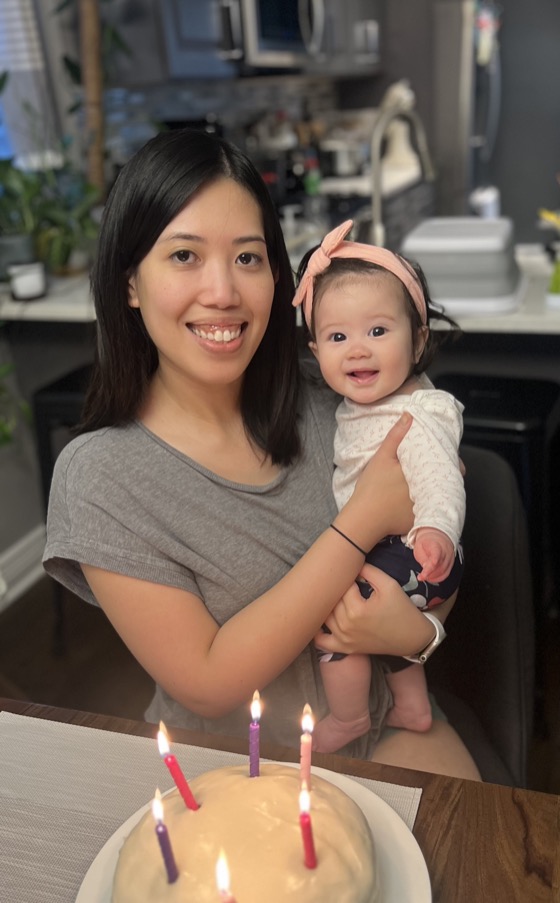
Katherine holding Lily, 2023
Katherine with Lily, 2023

Shortly after our daughter Lily turned one, Katherine was diagnosed with de novo metastatic triple-negative breast cancer. Katherine approached her diagnosis with precision, discipline, and an unwillingness to lower the standard. She leaned in, focused on treatment, and continued showing up for her family.

Along the way, we discovered something that should not be true: the years immediately following childbirth, one of life’s most meaningful moments, are also among the most dangerous for breast cancer outcomes. And medicine has not caught up.

“This foundation exists to close the gap between what we know about postpartum breast cancer and what is being done about it — with the same discipline we would apply to any serious, solvable problem.”

The biology is actionable. Postpartum involution, the biological process following weaning, creates a measurable, time-limited window with multiple actionable pathways. This is not vague cancer biology. It is a specific physiological window with known mechanisms, preclinical evidence, and early-stage human trials already underway.

The field is not saturated. A small number of focused researchers are doing meaningful work with limited resources. One well-resourced cohort, one linked data system, one biospecimen bank change the research surface area for everyone who comes after. This is exactly where focused philanthropic capital has asymmetric impact.

Progress is not constrained by ideas. It is constrained by infrastructure and focus. We are here to provide both.

What We’re Building

Three focus areas that unlock the field.

We invest in areas that unlock the rest of the field, starting with the foundation required to understand this disease at scale.

01

Research Infrastructure

Building the systems that make rigorous study possible.

  • Linked obstetric and oncology data systems
  • Prospective postpartum patient cohorts
  • Tissue and biospecimen banks
02

Translational Research

Connecting postpartum biology to clinical outcomes.

  • Findings that can inform interventions
  • Time-windowed postpartum involution studies
  • Mechanistic work with near-term clinical pathways
03

Field Building

Attracting researchers who choose to work in this space.

  • Targeted grants and fellowships
  • Early-stage and pilot funding
  • Diversifying the research base
Our Discipline

We are deliberate about where we allocate capital.

What we fund

  • Research with direct postpartum-window focus.
  • Shared infrastructure: cohorts, linked data, biospecimen banks.
  • Translational work with near-term clinical implications.
  • Early-stage grants and fellowships that attract new researchers.
  • High-leverage work where one investment enables many others.

What we don't fund

  • Broadly defined breast cancer research without a postpartum focus.
  • Areas already well-capitalized by pharma (e.g., blood-based detection).
  • Overhead-heavy institutions where grant dollars don't reach researchers.
  • Late-stage clinical trials better suited to federal or pharma investment.
  • Awareness campaigns without a direct link to measurable research progress.

Our goal is not to do everything. It is to do the highest-leverage things well.

How This Works

Built to last. Not to spend down.

Founding pledges are invested in a permanent endowment. Research grants are funded from returns. Principal is preserved indefinitely. Early donors are not writing a check to a moment. They are co-founding an institution designed to outlast all of us.

  1. 1

    Gather founding commitments

    From our full community: friends, family, and mission-aligned supporters of every level. Every commitment counts.

  2. 2

    File for public charity status

    We file for 501(c)(3) recognition once founding commitments reach sufficient scale, built on demonstrated conviction, not on a projection.

  3. 3

    Invest in a permanent endowment

    Committed capital is invested in a permanent endowment. Research grants are deployed from returns; principal is preserved indefinitely.

Investment philosophy: broadly diversified equity and fixed-income ETFs (80% equities / 20% bonds), rebalanced semi-annually. No active managers. No performance fees. No complexity. Most managers don't beat the market. We aren't going to try. We'll let compounding do its work and focus our energy on deploying the returns well.

How to Be Involved

Make a founding pledge.

We are gathering founding pledges from friends, family, and mission-aligned supporters of every level. This is the community that will help establish the foundation before formal filing.

Share your interest below. We’ll follow up personally to talk through what a pledge can look like for you. No gift is too small to matter here.

Share Your Interest

All commitments help establish the foundation before formal filing.

The Standard

This should not remain an underfunded area of research.

Outcomes for women diagnosed in the postpartum window should improve in measurable ways. Families should face a system that understands this disease — not one that is still catching up to it.

We are building this so that it becomes true.

For Katherine, who grew determined when most people would have fallen apart, and who shows up every day so that Lily has her mother. And for the 5,000–7,000 families each year who deserve better than what we had.

Make a Founding Pledge